The Welcome is the opening of the Factory international/ Aviva Studios venue in Manchester’s newest cultural venue. It is where the original Factory International moniker returns, the point at which two years and more of effort and voluntary energy is released. Across the venue, a rage of events and activities are running for nine days in November and allow the 10 boroughs of Greater Manchester a representation here, in this cultural hub. There is so much to support and love about this, The Assembly, made up of people across the boroughs, creatives and not, activist and enthusiast, all voluntary and all filled with energy yesterday. This is a major event and one they have created between them to celebrate a part of the behemoth that is otherwise easily missed, that network of community that was always expected to infuse the venue and its offerings. It was notable the prevalence of Factory International logo and conversation with the Assembly members, they were here before the money issues, before the Aviva finance package. They bring that with them, the original ethos of community and diversity. There is a legacy amongst them of the Manchester International Festival and a clear belief in the power of arts and creativity to build a space, to do so with people and now with a building. A gigantic and impressive building, at that. The podcast continually returns to this as ‘a building like no other’. In what they hope to bring, site specificity is crucial. That means nothing without people, as much of new Manchester shows, the building is often despite the people. This is different here, there has been an attempt from inception to include arts and creativity, and people.
This whole trip has been amazing as we travel around and I look for a place in the world that does not involve destroying it, or making it a system that will kill us both. That may seem high faluting, but I do most of my faluting when writing and especially when deep in thought and need philosophical disemboguing. I have long thought nature was the answer, the deep time spaces of evolved worlds and ways of being that resist the ugly commercial hardness of cities and towns, of people when crushed together. Sometimes I think my whole life has been about this, the searching for calm and beauty, depth beneath those surface rushes everywhere to turn everything into cash or profit, status or power. Not in any great way have I done this, a life of crushed spirit and joyous revival when I find things are not all bad. Often these concerns involve theories and quests to find the people and thinking that make the world better. Most often they come to nothing, although finding other questors often feels enough in itself. Mostly, I find the closest to perfection comes in moments far from any cultural or written evocations and is found when shattered but immersed in a world too complex to imagine, but that awareness of being within it is felt, not thought. There is a zone of being that is beyond thought but feels like the most enlightened thinking possible. That came for a few days in a little place called Ropa, on an island called Mljet, off the coast of Croatia and part of that country of islands.
I am writing this on the ferry away from Dubrovnik and onto the island of Mljet, national park and lakes. The visit to this departure point in the Adriatic was something that initially I thought I would leave unwritten, unsaid. The twelve hour journey from Virpasar, although initially exciting with train and buses through Montenegro, was wearisome by the fall of darkness and the fully laden climb up ridiculous numbers of steps to our new home. The view from the balcony there was ultimately rewarding but it did not feel enough after that torture of what we later came to know where named the twelve stations of the cross. I can well believe it, and my Catholic upbringing forbids any further flippant comparison between crucifix and rucksack, but I was finished by the summit. Maybe this start, the exertion and the paltry reward of water and a packet of cheese and onion, was part of my initial sense of underwhelm in our new city.
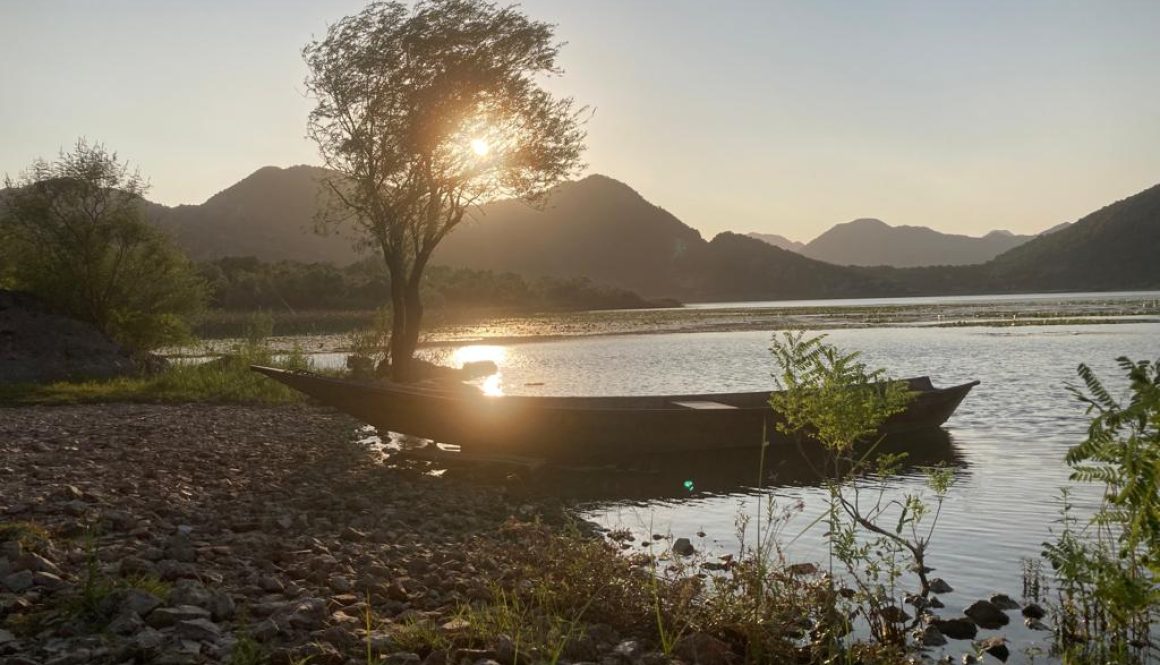
Adventure is often stifled by the idea that there’s nowhere left to go, it’s all been done. After a single full day at Skadar Lake my zeal for adventure is revived entirely. There is so much unseen and massive opportunities lie everywhere. On the border between Montenegro and Albania, the lake has shores in both countries and incredible riches between.
This was the opening title and closing thoughts of a biographical approach to Samuel Beckett I watched on television.
I was watching this while thinking how I could make a trip to India matter to my thoughts of the north, our northern heritage and future north thinking. I wanted so much for it to be, and it felt so much that it should be.
And it is.
All things are. We cannot have an isolation of region and our wanderings as northerners and the wanderings of others to this north, they make what things are. Place is only meaningful because of the movement between.
It transformed me, India. I never wrote while I was there despite thinking I would write every day. Northern India, Rajasthan, Delhi, Agra. Wild cities, desert edge, mountain top temples and fire lit courtyards in marble palaces. I wrote nothing at all as every second of time burned bright images in me and swung me this way and that, belly deep. I worried how the continual desperate snapping of camera seemed to catch nothing but tiny reflections of what I wanted to keep forever. The seconds, minutes, hours and then generations that bound together like the tiny knots in the carpets weave showed the flawless dexterity of craft through millennia. Each knot so tiny as to be imperceptible, the perfection only revealed when the whole expanse was flung from roll to wide carpeted brilliance.
I never wrote while I watched those nimble-fingered carpet weavers. Not a word, as they sung to each other the song of form and colour, the harmonic codes of symmetry and shape. Songs, a revelation. Who knew that every carpet crafted held within them these songs of magic and perfection? Not me. The words still did not come. This was a lost world of the deep time crafts we now marvel at but cannot grasp or hold. Sat in the wool haze of this weaving room, eyes flickering through microscopic organic dust of this ancient creativity. Not a word came, maybe none dare challenge this series of chanted directions.
On train journeys through lush green and then bright mustard flowers, the dramatic flourish of a vivid red sari amongst three tiers of cadmium yellow, goats in dust clouds on arrow straight highways, fires and gold and growth. Long staring faces and others with universe bright smiles, my own stranger face here in this landscape for the first time. All that could come was the click of a half-remembered camera shutter, forlorn hopes to make aspic still that which was everywhere, alive. Futility of capture in a teeming lifeworld that strummed across every fibre I had.
Writing was impossible.
In these flying past train rides, trundling through, then plodding aimlessly within worlds, I saw that everything is here, including us. Strange and familiar, all the same, just strung differently. Made uncanny. In desert landscapes where crops waned against harder yellow soils, huge red brick chimneys grew high. Familiar, but here still belching with smoke and not the trees that spout out of our remaining Northern spires. No terraced houses or mills beneath these monsters and each stark steeple proud against brilliant blue skies, at once the same and still impossibly different. Humped backed cattle and macaques picking through silhouetted mounds and us here too, lost histories still echoing of a cotton trail and a working life beneath heartless temples of redbrick smokestacks.
This world that hummed and throbbed, that teemed with activity and making do and getting by. Our world too, a part of it never yet seen by most, at least not by me. Eyes alive, frequencies altered.
Not a word written.
In jewellery workshops in Jaipur, the world sends its precious stones. They always have. Since before time was recorded in ways we can listen. Craftsmen here were the same colour as the gems they shaped. Every surface water and dust, the emerald green fingers and cloth only their eyes shown out, focused on the rocks they shaped into jewel. I was drifted back to grandad in his Ashton back kitchen, ‘if coal dust were gold dust we’d be laughing’ he said. It was not and it clogged, clothes and lungs. He lost his leg to those tiny particles rather than collapsing boulders, as my child self-imagined. Would this precious gem dust do the same? This workshop was something of a performance space, created for us, and in thousands of Jaipur village rooms the same goes on in shadow, homes coloured through emerald, topaz, ruby, agate, the incredible lapiz lazuli. Each stone its own experts, that know its pressures, it shapes, through generations the same stone and the same crafts. And here it is, underpaid but simply perfect. A living craft that reminds more than any report or statistic what we have ourselves lost and lost forever. These ancient threads, once snapped, cannot be restrung. How much more are they valued? Here, the art is clear and beautiful, and as each worker stands from workbench or loom and walks through showrooms of opulence, they do so aware. Unlike the dust and the staining of geological hue, the wealth does not stick to them as they make their ways home. This is craft through the ages and I look again at the towering monuments of UNESCO and the marvellous and the marvelling we all do in our millions. This dominating wholeness, these incredible places of marble and precious stones, this mesmerising gem lit opulence. Every tiny inlay, like every tiny carpet knot, essential to build the massive. Remember the visionary, the grieving maharaja, the forlorn majesty. Remember more the efforts of body and village, of generations, of eons of craft and dedication to form a beauty of forever from the hard rocks of distant mountains. Remember them, and we can remember our own lost past. For every Taj Mahal, let the perpetual, unheralded graft of the many wash over us with the same miracle sensations that the giant, the completed, the whole allow.
Now, in our forgotten empires of empty mills and rewilded slag heaps, remember those that toiled. We came from that too, not just redbrick and coal dust. All I could see in the shadows of the Taj Mahal, the Amber Fort, Red Fort, the City Palace, was us and the history of the unrecorded, the pillaged antiquities stripped away and all that was left was the craft that created them.
I saw all this and could not write a solitary sentence.
There is an energy in the way all things overlap. Inequality we shared from our own histories, it remains here, as it remains with us. India acts as a polished lens probing deep into ancient exploitation, of warriors, oppression of thousands of years. And on the edge of eternal chaos it thrums as perfect life. The epitome of how things are. There is dignity in every act and maybe why there are three million gods. Everything holds something to be thankful for, to celebrate, to look beyond the ordinary. It feels like the eye of everything and there is no possibility of a word being written. Wandering every street or hillside, lake or market and the temples appear in the middle life. Shrines appear everywhere, in trees, in the middle of the road, behind a chai stall, random eruptions so that you never really know which is everyday life and which is sacred. And then you realise, it is always both all at once. India is a universe in nebula form, ancient flows and the right now, it can only be lived, that’s what I thought, but I could not write that. Not then.
Meditating Monkeys on Goblin Built Palace Domes.
Bundi Palace, the work of goblins, not of man, said Kipling.
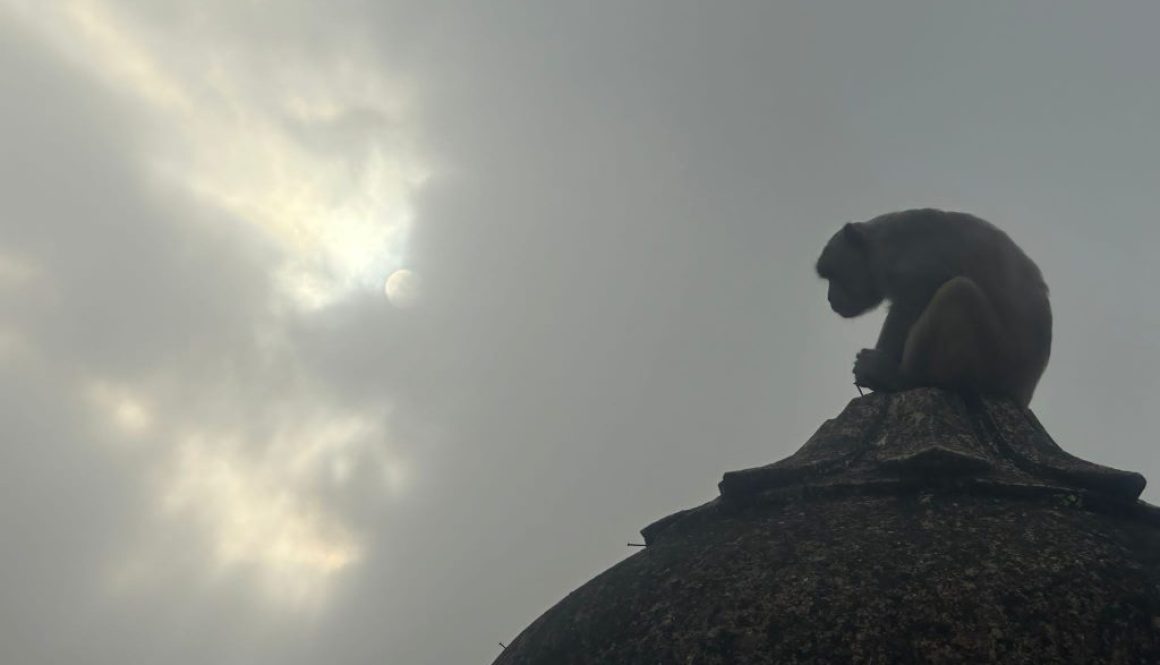
Amongst the tumult of life small moments tingle still, bring the pen to the hand and both to the paper. One of these was Bundi, a desert edge town of no size compared to most we had visited. Still beyond words, mine at any rate. Kipling said of the palace here that it was, ‘a Palace as men build for themselves in uneasy dreams—the work of goblins rather than of men’, that in 1888. I thought that clumsy, the description of these shapes of palace and mountain side all the same and never quite sure which it is, until granite elephant or stone peacock emerges, or window or ledge or one of the hundreds of doorways and passageways opens ahead. I wanted to ignore Kipling, but then read him and it is brilliant, and 14 decades on the life inside is lesser, but the same decaying majesty he found, remains. It was not abandoned then, although he imagined it two hundred years before, in another prime it had lost. In Kipling’s wanders, the pigeon post would still have been cooing, now empty wooden boxes are all that show this visible feathery line of flight and fancy once served a purpose. The town streets beyond still teem, the temple still sings out in vivid song and colour. Kipling said the accents of Bundi were unfathomable, a brilliant American documentary maker on our visit had just finished saying the same about mine. Words are never just simple routes between us. And it is what lies beyond words that always says the most. Amidst the peepholes and passageways, tunnels and hidden depths of this mystical ancient rock palace, the thing that stays with me materialised. Up above, atop the smooth dome of the palace walls was a meditating langur monkey. absolutely still, staring across the streets below. I saw for the minutes she transfixed me, the timelessness of her watch, her gaze. Her ancient presence had been here in generations before the dome, before the palace, or the streets beneath. She and her ancestors were both part of, and apart from, this scene. An hour or more later, in the huddled backroom of the chai stall, I looked up past the steaming brass urn and up the bustling trades of the street and up to the skyline and the place. There she was still, unmoved. Looking out into mist and sunset. and it was so clear then that she would always have been there, her and her ancestors, looking over Kipling, over invading armies and splendid celebrations and coronations and strife and labour and laughter and worship and all of it. The past dissolved in that monkey stare, two universes eternities apart and yet cheek by jowl. I tried to imagine myself in that simian skull, impossible. But for a second, fleeting, maybe imagined, it hit me. The stop in the flow. The everything and the always all at once. It was seconds long, but all the expectation of India was clearer in those seconds. Not earnest holiness as perhaps anticipated, not enlightenment. It was the simple seeing of it all as already there and here, of everything and nothing at all. Right there, alongside each other. The treks around the Wigan Alps in ripped jeans and mucky shoes and cold fingers and gaping upwards at ravens in trees. Intense life and absolute stillness, just a breath away from each other. So close, if you could give yourself up to it, a lifetime’s endeavour to even contemplate, but if you did, you would see they are exactly the same thing. And then, a falling back that would have no landing, a tumble into the otherness that India invites us in to see.
First Dance,
Then Think.
Dawn over Pushkar
And now, these first days back and everything seen there resonates here, maybe without the reification of the everyday. Back to the tendency to let the marvellous become grim not glorious. We see ourselves more in others, where frequencies alter and we try to make sense and cannot and only find the patterns when we give up, relax and let the flow happen. The pathways of travel are not geographical and the moments that matter evade the click of the camera. Words then, in those moments, do not come. Only now do I cling to them as a means of making something solid of that magic ether. We must dance first, and that dancing can be in the streets and hills of here, of the familiar made uncanny by knowing we are part of the universal at every second of life.
I am not sure of the purpose of writing this or sharing it. I feel it has some, it is an invitation to something, and I am not certain what.
References:
Dance First. (2023). Directed by James Marsh. United States: 2LE Media, Film Constellation & Proton Cinema.
Kipling, R. (1888). Letters of Marque. Found at https://www.kiplingsociety.co.uk/journalism/letters-of-marque-17.htm