Destriers: Twinkling Stars of Rage and Control
Light is a funny thing. Our first mysteries of the universe thinking might begin learning the stars in the sky we see are lights first cast millions of years before. It takes some thinking about that, and we generally stop before reality collapses.
The past has to remain where it is for us to function in the present. The past glaring so openly up there in the night sky, dancing and blinking and flickering away is both mystery and mockery. They offer a cruel playing with our sense of importance, our purposes and beliefs, these photons of forever. The past, today.
Not all past needs the illuminated power of a trillion nuclear explosions. Some pasts linger almost imperceptibly. They are perceived, you know they are there. Like the mystery of the stars, it is easier to ignore, more peaceful that way.
Peace is like that.
or at least the disruption to it.
Violence.
Jamie Holman uses a riot stick just to ensure we do not let this comfortable ignorance persist too long. The Erection Holman provides in a glass cabinet calls out, a call answered despite reservations. Purposefully presented as an erection, an erection that in every showing has dildo as likely a term to be uttered as riot stick. Not one of us is considering the 30 000 year old dildo of Hohle Fels either, just the titillating uncanny of the possibility of a fake penis. Not just Carry On film titillation, these involuntary giggles spark deeper lines. This ceramic truncheon as objet d’art, closet sex toy, conceptual thought piece includes the crossover of patriarchal power, of perpetual sheathing of sex through weaponry. Swords and their legendary swordsmen, truncheons, meat cleavers, cannons and a whole host of weaponised phallus imagery. We talked once, me and Jamie of a T-shirt in a Lancaster shop window; Fuck the Patriarchy. Was it meant as irony? This brutal violent imagery of sex and violence and power and control? Or was it that the language of oppression was all we could see now.
And all of that irrelevant because this is a riot stick.
An erection made to fuck you up, not fuck.
The shock of that seemingly less because we are more able to cope with the horrors of everyday violence in policing by consent than by the embarrassment of a misnamed knob.
And this is ceramic, and fragile, and beautiful.
Across every piece in Destriers violence is there, in plain sight and often tempting and pleasing, but deadly. Like arsenic in your cocoa. What Holman does in a panoply of imagery over years is show the routine in violence, and the easy routes to camouflage we have adopted. These are shot back at us with a velvet glove to the chops, high speed, two to the ribs and one in the knackers with a silk weave clad knee. This goes from the celebration of a murderous cavalry in the thousand-year-old Bayeux tapestry, through the made-heroic charging of high-viz militarised equine enforcers terrorising a mining village, to the stampede over football terraces.
Nowhere perhaps is this more clearly thumped home than in the juxtaposition of balaclava and family photo of In Every (Dream) Home a Heartache. The there/ not there, the seen/ invisible that exists in every moment.
Shift the frequency and maybe you can see.
Holman’s work is a wild spin of the frequency dial, and the motion can feel a little nauseous. This is violence in the here, now and there, with you and yours, and not made Hollywood by cinematic distance and televisual sanitisation. We are part of this, and we choose not to see it. Comfortable monstrosities.
The beauty of the rubber bullets in ceramic fragility, beautiful and precise. Gorgeous little trinkets you could place in a specially designed cabinet behind the Constable print of just about idyllic England. Or have bounce of the back of your head fired by an irate constable with a lust for peace, a craving for order.
This is lovely violence, violence made twee. A violence William Morris might have appreciated if not embraced, when socialism was a set, not a struggle. It still is, for many. Both are necessary, both reveal each other, the privileged patronage and the struggle of abandonment. In Holman’s work the tension poses serious questions, about how easily we can fall into traps of conversational politeness, saccharine perfection; concerns emerge that seems ridiculous, of craft and surface, colour and form and that tempt us to forget the wielding truncheons and state sponsored charging cavalry. It is the ways to manage a rage so suppressed and so continually subject to violence, it needs to eke a way out. This is Benefit’s Street revenge. The working-class artist upturning the mockery of the media production companies, the veils of Chantilly lace, the creation of clowns to mollify the aghast. It has always been thus, Holman reminds everyone. The echoes of the Bayeux tapestry inspired The Chase, the stampeding equine wall of control. The depth of rage from those at the receiving end courses through the collection, a rage reviled and compressed, “We have been baton charged since 1066″ Holman tells me. Although the rage has been documented, redrawn, photographed and sung about, even if this anger as an energy has been shunted about for decades, this collection feels different. This does not give space for informed anguish to empathise and sympathise, for it is these legacies of distanced alliance that is under attack. Not shared repulsion at the brute force of the constable on overtime and a conservatory to pay for. This is an attack on the comfortable, the drawing room of meditative reflections on how horrible oppression is, while always part of it.

There is art here, craft obviously. Art and Craft. Middle class gorgeousness, the appeal is there for ‘calm down dear’, ‘Easy Tiger’ pacifiers, collectors, curators. There is nothing like the condescension of a florid faced isolationist in a secluded cottage to make this whole crafty camouflage work. Each piece would look great in a barn conversion overlooking cropless, futile fields of past victorious thefts.
What a thrill it is to see some resistance of humility over patronage lying behind these perfectly crafted artefacts. Each as bright stars of rage in a night sky of wet blanket greyness, burning through, visible in both worlds. These little machines of resistance so deftly produced they can fit next to the drab art of paunches and tired condescension, water coloured emptiness and easels on hillsides and readings by firesides. The uncanny, these blue and white glazed pieces could fit in inheritance money galleries in market town high streets next to ceramic cows and asinine watery coloury spaces with the troublesome realties eradicated. Imagine, the riot stick and the rubber bullet and high tea and self-congratulation. A thousand years. An enemy within. And without.
You will never see a police horse at a middle-class event. Not at a gallery opening or the opera, not here. They may show up at a horse parade or gymkhana, regal in their Sunday best. But not when they are at work, in charge, in FULL charge. The kind of horror that 24 Hands brings to the lamplight of memory before we swing it away and out back in the shadows. But 24 Hands is big in every sense of that little word, so Holman insists on it being seen, before decorum is restored. Twenty Four hands is both the height of the police horses and a handy measure for the number of people that would constitute a riot under Public Order Offence Act, that being twelve. This piece is big, and it is clever.
Despite the horror depicted, previously people have looked at scenes of violence and approached Jamie to say they are there, in the images of football inspired disorder, of Samba and Who Are Ya? Probably others will see themselves in these scattered fields of mayhem. Only certain people, of course. Those people desperate to move these inviolable artifacts from symbolic rage and make them alternative nostalgia sections of the local newspaper. A past remembered even when they were not the ones in it at all.
That never matters, the past can be recreated anyway you like. If you know how.
Make it nice enough and that version sticks. They have known that a long time, the middling ones, their bosses. We are still learning it and still bedazzled by inclusion – even false inclusion. Better than never being seen at all, which has been the case for almost always. And that is another angle of this – representation of the invisible. See up close as well as behind the tv screen, the high vis, the condemning narrative of a BBC newscast. Made big, made heroic. The two sides, exposed. Better this, we think, than the clumsy nostalgia of William Morris and BBC and Daily Mail pretend realities they hope will stick. But when you are the eradicated ones, even monstrous representation is a visibility of sorts. Often enough, people start to become that they have been shown of themselves even when they know it is (was) not true.
No truer than the pretend worlds of the outraged in easy chairs, and nobody seems to mind their self-deception. We built a country around it.
Returning to these places and events is not new in art and the paths from there are well trodden. But not like this. Now the nostalgia and pretend outrage of things long past is made the focus of the work. No simple nor comfortable radicalism, no apathetic antagonism of Marxist angst dissipated in hot tub or wine bar. This is a revelation of those pretend perspectives that have the anger but without the desperation. Here it is, the collection says, the hidden in plain sight violent history of oppression and suppression that bore us.
Playing in the air, continually, is the Century of Violence, as it was experienced most familiarly as disconnected and distant reports through an old wireless. Records of so much violence, so many examples of where heads were hammered, and horses reared and batons swung and bullets fired. Not so much the more common experience of heads hung in shame or buried in sand. This is also such a tiny list, such selective examples, the beauty spot that reveals the whole ugly edifice.
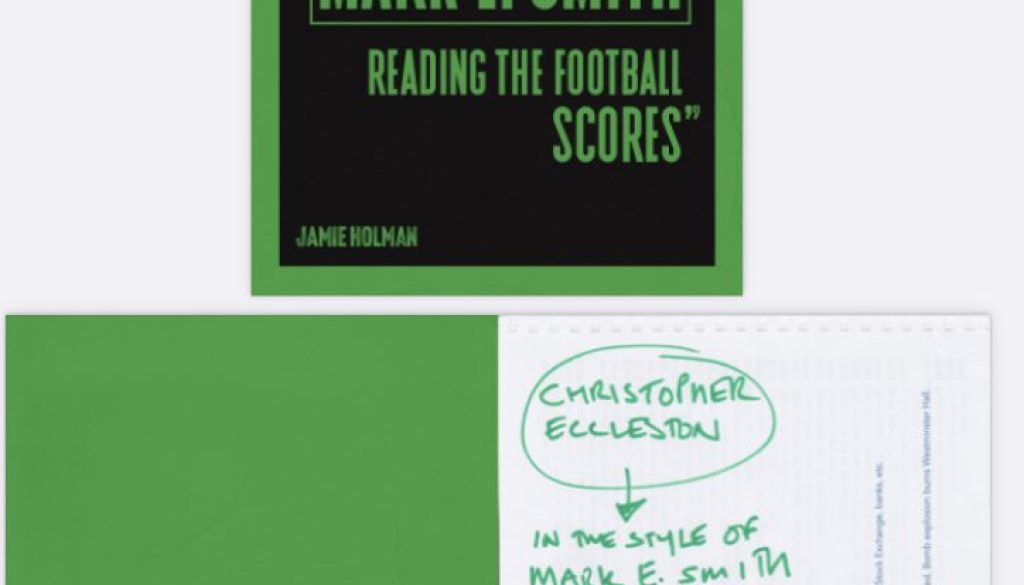
The voice in A Century of Industrial Violence (‘it had to be Christopher Ecclestone’s voice’ Holman insists), becomes mesmerising. Like the football scores, or an alternative ‘tracks of our years’ radio show in which people chart their lives through music releases. Here, the tracks are blood red and deep, violence, death, rebellion, injustice, destruction, unrest. The scores, as they come in, are never uplifting, no David and Goliath upsets. It is only ever upsetting. Over this century of civilian rebellion and violence, the strong arm and fetlock of the law, we see patterns. Of industrial unrest, of colonial shatter back reverberations, of destroyed industry and the ramifications in streets, football terraces and later in raves.

Of mills and factories now emptied, scenes of strikes for justice and decades later filled with dancers; both met with warrior police.
Eccleston’s own roots are here, with ours, amongst this mess of mayhem and control. And this matters, voices matter. Accents, lives, histories, words and deeds not obliterated by a polished veneer of respectability, once the dust settles. That is what echoes here, in sound and image.
The eternally recurring fractal geometry of violence.
We are continually shaken from any happy history conceits around our own lifetimes. Holman shakes out any lingering golden age remembrances, we are left in no doubt of the brittle peace we might choose to cling to. The Tony Wilson statue of Manchester or cultural Factories that are neither the original hellish smoke stacked industrial ones, nor the ironic versions of Avant Garde New York. New places, where community is a commodity at the backdoor appeasing sky high ticket prices at the front. We can claim creative high ground, find solace in tunes and old school (or skool, for god’s sake) fliers and legendary DJ sets or spaces and places revived for new buyers. Not here though. Not in amongst the continual reminders, sonic and visual.
Dishing it Out casts truncheons and riot sticks in the veneer of gold leaf and the language of earthenware and kiln fired objet d’art. It is not overseas this violence, not tailored for television and made safe. except it is. Almost. The balaclava figure in the family home, not any home but the aspirational dream home, the shock is not the balaclava. We are used to them. It is where we find that balaclava, in every home. We are not disassociated consumers here unless we choose to be. Unless we are immersed in the patterned decal visions of a merrier England on ceramic rubber bullet casings (17 Piece Service). We can marvel at the equine grace in Suggestibility, Anonymity and Contagious Acts, see the beauty, the grace, the power. History, a place safe from stampeding hooves, where Peterloo is a film and football violence a fond memory of youthful rebellion, sport casuals and different tunes on a juke box. Where armistice is ‘lest we forget’ while we continue tactfully forgetting those first armistice days that torched Luton Town Hall and saw multiple riots in 1919.
The last century began in black and white and was silent, yet all the time it was neither. The complexities of fascism, of struggles and rebellion, of Latvian anarchists like Peter the Painter, manufactured models of outrage amongst the purely outrageous. Now what we have left are remodelling of pasts, some distant and some our own. New histories that ignore the violence and claim only the shopping opportunities, the ticket sales, the perpetual renaming of any salvaged sense of community. We have swapped folk demons for folk heroes now their fire is out, some get statues depending on their tradeable legacy. Even Peter the Painter lent his fabricated moniker to the C96 Mauser Pistol that was prevalent in the Irish Easter Rising. Sometimes the monsters created to frighten us emerge from the imaginary and do more damage than purely existential. As a teenage infantryman, Holman’s dad was shot on the Falls Road. Not by a Peter the Painter. But by someone.
Violence as the soundtrack of our lives resonates here. We all have our own.
I was always aware of being freshly exposed to another soul’s frustration borne of damage and ripped flesh and death and mutilation and vicious control and…and….and. The violence then later repackaged, sold as a series of narratives and histories that obliterated the reality and the suffering. There is no market for that. We know as good capitalists, ‘sell the sizzle, not the sausage’, we live as good citizens by, ‘sell the statue not the shell shock’.
This collection plays with our delusion and throws it back. Not only as visual artifacts, but sonically through Eccleston’s haunting procedural narration of horror, every date a life changing moment of violence for some. And the many more unrecorded, we might follow these tracks and start to think of our own. Not the usual encouragement in a world that persuades us to forget, lest we remember too much.
We are so good at forgetting while we convince ourselves we remember. The comforting mantra of Saturday teatime football scores, the Top of the Pops sparkles that mask the heartache in every home. It is here without being obvious, it is raging anarchy and twee middle England, it is splintered bones under tea cosies, it is Madchester DJ revival night posters pasted over suicides and abandonment. It is true of course, a better story to say we all danced because the DJ was so good rather than we all danced because we had nothing else to live for. Our constantly forming narratives we allow to get more golden and even help with some layers of our own. Each of us a part of the fuel in the kiln that fires these new, happy veneers.
We can spend time strolling in the air-conditioned tapestries of deception and that is fine, the whole exhibition tells us this. It is fine in our happy spaces discussing 1968 riots in 21st century coffee shops and selecting our chosen tracks, our favourite insurrections. We can, if struggling, go right back to the Destriers, the originals, the heroically mute Bayeux thousands. A classic tale that allows finding ourselves on the ‘wrong side of history’ to be swiftly corrected. Go back far enough, we are all pure.
The end of the exhibition for me is trying to see the cavalry of Norman invasion in the canvases of police horses, listening to the Century of Violence reach its end. Holman describes the energy behind this work and that this was no distance achieved moment of calm, of clarity. He says, ‘I’m constantly embarrassed about how angry I get…when I go blood red and fists clenched. But what else would we do? They’ve been baton charging us since 1066′.
It is chilling to see how easily we have commodified violence. Even our own experiences, of lone teenagers beaten stupid by school aged gangs and old manipulative fascists, we allow to become Green Street and Football Factory cool. When we reify the acts but forget the cause, all is lost. At least, all is quaint and nostalgic, safe. Like the celebration of the art of a tapestry, the weaves and the talents and the acts of preservation it has involved, we so easily lose the brutality.
The end of the century we have here is the perceived disruption of a millennium bug. Maybe a fitting marker for what has followed in the first quarter of the new century. The bug that never quite happened, the existential, the absence that shapes the present. Every decade of the last century saw the change in where violence came from – but little change in how it was dealt with. Our digital age seems to be showing more of the same, coming as it does after a hundred years of unforeseen consequences, of poverty, war, colonisation, migration and the continual crushing of working-class resistance.
The clumsy reappropriation of territories by colonial thinking leading to carnage and horrors the world over.
Our new digital windows on the world blind us, our own older narratives seem more ridiculously manipulated to support hideous models of exploitation. As the layers of history are laid down, as the violence becomes tapestry or film or legend, as the blood dries and the protagonists die, the weapons remain, and the threat is always there. As we surround ourselves in Holman’s work, we see how petrification occurs, and we can shudder. The enemy within is always necessary, and once they (or you) are found, the results are right before our eyes.
We needed to remember, but we do not.